
April-May
Students are sometimes curious and often ask questions about the world that surrounds them. With the help of project «World Around Us » children are provided with the opportunity to explore and investigate these questions and come up with the answers.
The aim of this project is to enlarge students’ vocabulary,and why not to enlarge their knowledge.
Srudents are allowed to choose the topic. They find information about the chosen topic,translate them,then we discuss them.The discussions will be shown on our blogs.
We’ll also have educational trips to enjoy the world around us.
Art is my life
Art is a diverse range of (the products of) human activities involving the conscious use of creative imagination to express technical proficiency, beauty, emotional power, or conceptual ideas.
There is no generally agreed definition of what constitutes art, and ideas have changed over time. The three classical
branches of visual art are painting, sculpture, and architecture.Theatre, dance, and other performing arts, as well
as literature, music, film and other media such as interactive media, are included in a broader definition of the artsUntil
the 17th century, art referred to any skill or mastery and was not differentiated from crafts or sciences. In modern
usage after the 17th century, where aesthetic considerations are paramount, the fine arts are separated and
distinguished from acquired skills in general, such as the decorative or applied arts.
Throughout time, philosophers such as Plato, Aristotle, Socrates, and Kant, among others, questioned the meaning of
art. Some of Plato’s dialogues relate to questions about art. Socrates says that poetry inspired by muses is not rational.
He speaks fondly of this other form of divine madness (drunkenness, eroticism, dreaming) in Fedrus (265a-c), yet in the Republic he wants to outlaw Homer’s great poetic art laughter. In Ion, Socrates makes no reference to Homer, which
he expresses in the Republic. Ion’s dialogue suggests that Homer’s Iliad operated in the ancient Greek world, as the Bible does today in the modern Christian world.
As for the literary art – the art of music, Aristotle considered epic poetry, tragedy, comedy, dithyrambic poetry – music
to be a mimetic or imitation art, each differing in imitation according to the environment, the subject և the horse. For
example, music mimics rhythm-harmony media, while dance mimics only rhythm and poetry mimics language. Horses
are different from their object of imitation. The comedy, for example, is a dramatic imitation of average men. while
tragedy imitates men a little better than average. Finally, horses are distinguished from imitation by their narrative or
character, through change or no change at all, in drama or drama. Aristotle believed that imitation is natural for
mankind և is one of the advantages of mankind over animals.

20th-century bottle, Twa peoples,
Rwanda, Artistic works may serve
practical functions, in addition
to their decorative value.
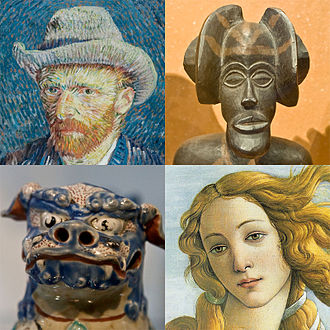
Clockwise from upper left: an 1887 self-portrait by Vincent van Gogh; a female ancestor figure by a Chokwe artist; detail from The Birth of Venus (c. 1484–1486) by Sandro Botticelli; and an Okinawan Shisa lion
 Նարե Խաչատրյանի բլոգ